upcoming
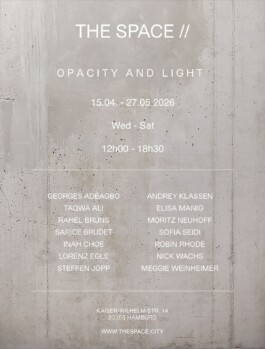
THE SPACE //
presents
O P A C I T Y A N D L I G H T
works and creative productions by
GEORGES ADÉAGBO TAQWA ALI RAHEL BRUNS SARICE BRUDET INAH CHOE
LORENZ EGLE STEFFEN JOPP ANDREY KLASSEN ELISA MANIG MORITZ NEUHOFF
SOFIA SEIDI ROBIN RHODE NICK WACHS MEGGIE WEINHEIMER
The exhibition „OPACITY AND LIGHT“ brings together the work and creative productions of 14 international
contemporary artists who explore the dynamic interplay between Opacity and Light - between what
reveals itself and what remains partially concealed. Through painting, sculpture, installation, and spatial
interventions, the exhibition approaches both light and opacity as aesthetic materials and as
philosophical conditions shaping perception, relation and coexistence.
„ THE RIGHT TO OPACITY WOULD BE THE REAL FOUNDATION OF RELATION, IN FREEDOMS“
- Édouard Glissant, Poetics of Relation (1990)
The exhibition builds on the concept of opacity articulated by poet, novelist, and philosopher Édouard
Glissant (1928–2011) – the right not to be fully understood - and places it in dialogue with light as a
metaphor for revelation, knowledge and clarity – yet also for exposure, classification and control.
Glissant’s poetics of opacity proposes an onto-epistemological resistance to rendering the other
transparent. At its core lies the dynamic between what becomes visible and what remains irreducibly
opaque. In his Poetics of Relation (1990), opacity resists reduction and total comprehension; it refuses the
impulse to make individuals, cultures, or histories fully legible. The „Right to Opacity” thus becomes an
ethical and political stance against the violence of reducing others to a known, categorized truth, which
is often a tool of domination. Relation, for Glissant, is grounded not in transparency, but in respect for
irreducible complexity.
Opacity preserves singularity, difference, and the layered nature of lived experience. Opacity is not
darkness - it is depth. It is an accumulation of histories, bodies, languages, cultural crossings, and memories
that cannot be translated into a single dominant light. It is the recognition that every being, every history
carries layers that cannot - and need not - be fully disclosed. In this sense, opacity also preserves mystery
and magic – understood not as superstition but as the living depth of the world. It arises where something
exceeds comprehension yet remains present.
Opacity, in this context, is not understood as a lack of clarity but as an autonomous mode of knowing. It
challenges the Western assumption that universal understanding is either desirable or possible, proposing
instead a "world mentality" that embraces diverse, untranslatable perspectives.
This exhibition unfolds in dialogue with Europe’s Enlightenment - the Siècle des Lumières, the Age of
Reason - a period that positioned light as the central metaphor of progress, emancipation and rational
knowledge. Across eighteenth century Europe, a vision emerged of humanity stepping out of the shadow
into rational clarity. Yet Illumination also interrogates, surveils, and extracts. It exposes, classifies, and
renders visibility in ways that can flatten difference. Every act of revelation produces shadow.
This exhibition considers the threshold between these two gestures: When does light liberate? When does
it erase and flatten complexity? When does clarity become overexposure? What kind of light do we need
today - a light that dominates, or a light that listens?
Immanuel Kant defined Enlightenment as humanity’s emergence from self-imposed immaturity through
the courage to use reason. Yet this exhibition asks: whose reason, whose light, and at what cost? Hannah
Arendt warned that excessive illumination can destroy the fragile space of appearance where plurality
thrives. To exist together requires not total exposure but relational space - intervals of shadow where
difference can breathe.
Thinkers such as Voltaire championed reason against superstition. Denis Diderot and
the Encyclopédie sought to catalogue and illuminate all branches of knowledge. David Hume examined
the foundations of human understanding. Light, in this European project, promised emancipation. Yet the
metaphor of illumination also carried ambivalence. To illuminate is to expose; to clarify is to classify.
Enlightenment rationality traveled alongside colonial expansion, scientific taxonomy, and extractive
systems that rendered lands, bodies, and cultures transparent to European scrutiny.
Glissant’s opacity offers a counterpoint to these universalizing ambitions. Where Enlightenment sought
transparency and universality, opacity proposes relation without reduction. Light, in this sense, becomes
relational rather than interrogative - illuminating without dissolving difference. Glissant’s opacity does not
reject light; it reorients it. It touches without dissolving. It reveals without demanding transparency. Opacity
is thus a form of care. He emphasizes that accepting another's opacity does not mean a lack of
connection; rather, it makes genuine exchange possible by removing the demand for conformity.
Throughout art history, light has functioned as revelation - from the divine radiance of Caravaggio’s
chiaroscuro to J.M.W. Turner’ atmospheric dissolutions, where form dissolves into radiance, allowing light
to exceed contour. Yet even in the Baroque illumination, shadow was never the enemy; it was the
condition of depth. Without shadow, no volume. Without opacity, no form. In the twentieth century,
abstract painters allowed light to emanate from color fields that seemed to absorb as much as they emit,
transforming perception into experience. Contemporary installation practices further shift the viewer from
observers to participants: light becomes material, atmosphere, and encounter - experienced rather than
merely seen.
In these practices, shadow is not ignorance but depth. Without opacity, light has no resonance.
As Gaston Bachelard suggessts in The Poetics of Space, intimacy resides in protected interiors - corners,
nests, shells. To dwell is to remain partially hidden. To belong is not to be fully exposed but to be held within
shared atmospheres.
Poetic language similarly sustains relational opacity. Paul Celan speaks of language that reaches
“toward an other” - not to possess, but to encounter. Inger Christensen structures her poems through
mathematical sequences that reveal ecological interdependence without dissolving singularities. Each
element exists in relation, yet remains irreducible.
The exhibition resonates with thinkers who extend or critically reframe Glissant’s relational
poetics. Christina Sharpe reflects on the ongoing afterlives of colonial histories and the forms of visibility
and invisibility they generate. Françoise Lionnet explores creolization and translation as relational
processes that resist fixed identities. Fred Moten articulates fugitivity and refusal as aesthetic and political
strategies that challenge dominant regimes of legibility. Chus Martínez emphasizes the poetic and
speculative capacities of art to imagine collective futures beyond extractive epistemologies.
Within contemporary ecological thought, light and opacity also shift beyond the human and
anthropocentrism. Donna Haraway proposes “staying with the trouble” - remaining within complexity
rather than clarifying them into simplified narratives. Human-centred Enlightenment placed humanity at
the apex of reason and visibility. Ecosystems acknowledge that humans are not the sole bearers of light.
They operate through entanglement, invisibility, and reciprocal obscurity beyond human centrality:
mycelial networks communicate underground; plants photosynthesize; oceans refract light beyond
human perception; stones retain geological memory. The world is not illuminated for us - it glows within its
own temporalities.
In the Phenomenology of the Spirit, G.W.F. Hegel identifies recognition as fundamental to selfhood: one
becomes oneself through being recognized by another. Yet recognition need not become forced
assimilation and total comprehension. Through Glissant’s lense, recognition does not require total
understanding. You can recognize without fully knowing. That is the ethical innovation of opacity. If Hegel
sought reconciliation of individual and universal, we might propose: reconciliation must preserve opacity.
Collective futures depend not on dissolving individuality into abstract universality, but on the preservation
of singularity within relation. Opacity ensures that individuality is not erased in the name of unity. Light,
when relational, allows connection without assimilation. Together, they model a form of coexistence that
resists both homogenization and fragmentation.
In an age of radical exposure - of data extraction, surveillance, algorithmic profiling, perpetual visibility -
of what the philosopher Byung-Chul Han describes as the ‘society of transparency’, opacity becomes an
ethical gesture. To protect the right not to be fully known is to defend plurality. To share light without
erasing difference is to practice care. What remains partially hidden - layers of memory, cultural
translation, diasporic relation, ecological entanglement - is not a deficit but a field of resonance.
This perspective also gestures toward older, more nature-centred modes of consciousness. Ancient
cosmologies and Indigenous epistemologies long understood light and shadow not as opposites, but as
complementary forces within cyclical systems. Knowledge was embedded in ritual, in seasonal rhythms,
in attentive observation of land and sky. Such practices recognized mystery not as ignorance to be
conquered, but as an integral dimension of existence.
The works assembled in the Opacity and Light move between concealment and revelation, luminosity
and density. Some invite immersion into shadow; others emit quiet radiance. Together they create a field
of resonance in which perception becomes a practice of attentiveness and imagination a political
resource. They engage with what resists immediate legibility or remains only partially accessible: layers of
memory, processes of cultural translation, diasporic entanglements, and the unseen dimensions of social
and ecological systems.
The exhibition proposes a poetics of coexistence and evokes a slower perceptual register, one that honors
opacity as protection and light as mediation - where the unseen, the quiet, and the non-extractable
become perceptible as aesthetic and political qualities. Community is sustained through mutual
recognition of depth. It is not built through total clarity but through mutual attunement. To coexist is to
accept that the other exceeds our comprehension. The mastery required to confront today’s global
challenges is not technological supremacy alone, but the cultivation of relational intelligence - an ethics
rooted in difference, reciprocity, and ecological consciousness.
The exhibition invites viewers to embrace ambiguity not as a deficit, but as a form of knowledge - and to
understand that what cannot be fully seen may still be deeply felt. Light as a medium of relation is what
makes relational understanding possible. Opacity does not obstruct; it protects depth. Light in this sense
is not an instrument of control, but a material of empathy. The realization of freedom today lies not in total
clarity, but in sustaining a relational equilibrium - where individuality persists, opacity is protected, and
community emerges as a dynamic, living system.
Sources:
Hannah Arendt: The Human Condition.
Hannah Arendt: The Origins of Totalitarianism.
Gaston Bachelard: The Poetics of Space
Gaston Bachelard: Water and Dreams: An Essay on the Imagination of Matter
Édouard Glissant: Poetics of Relation
Édouard Glissant: Kultur & Identität. Ansätze zu einer Poetik der Vielfalt
Édouard Glissant: Philosophie der Weltbeziehung. Poesie der Weite
Édouard Glissant & Hans Ulrich Obrist: The Archipelago
Byung-Chul Han: The Crisis of Narration
Byung-Chul Han: Psychopolitics: Neoliberalism and New Technologies of Power
Donna Haraway: Staying with the Trouble: Making Kin in the Chthulucene
Georg Wilhelm Friedrich Hegel: Phänomenologie des Geistes
Axel Honneth: The Struggle for Recognition
Françoise Lionnet: The Creolization of Theory.
Fred Moten In The Break: The Aesthetics Of The Black Radical Tradition.
Knepper, Steven; Stoneman, Ethan; Wyllie, Robert: Byung-Chul Han: A Critical Introduction.
Chus Martinez: The Complex Answer
Hartmut Rosa: Resonance: A Sociology of Our Relationship to the World
Christina Sharpe: In the Wake: On Blackness and Being
Charles Taylor: Multiculturalism and the politics of recognition
About THE SPACE //:
THE SPACE // is an an independent cultural initiative and exhibition concept within a curated format
initiated by the artist Sarice Brudet. Beyond exhibitions, THE SPACE // serves as a curated platform for art
mediation, dialogue, discourse, and interdisciplinary connections. Our goal is to promote contemporary
art and to create a space for encounters and synergies. At its core are community, togetherness, and
humanity. All resources that flow into the project remain within the project. This reflects our non-profit
ethos, our primary commitment to supporting artists, and our focus on cultural exchange.
The subject matter deals with cultural complexities in a global context, humanity as a practice,
coexistence, diversity, identity, social structures, the new sublime, relational aesthetics and the relation
between the human – technology – nature - biodiversity and the cosmos. Art is there to remind us of
humanity and the art of curation is to listen to and take care of the voices of each art work and the
human being behind the work. THE SPACE // wants to create a surrounding to make these voices heard,
seen and felt in relation to other art works, the viewer, the observer and to foster a mindful engagement,
critical thinking, personal interpretation and the sensibility to enjoy, to feel, to question and to encounter
a work of art with an open mind.
CURATORIAL MANIFESTO:
The exhibitions at THE SPACE // center around the human mind, body and soul and explore how society,
technology, and its relation to nature and the cosmos transform and shape the Self.
How do the Self and the perception of the Self correlate with the outside and its surrounding in a seemingly
unpredictable world shaped by globalization, technology and climate change?
How can the Self retain optimism to create change and disconnect from set and conditioned
perceptions, preconceptions and prejudices to alter these perspective, question the status quo, and selflimiting beliefs?
The artists included in the exhibitions explore notions and reasoning of contemporary consciousness,
constructive abstraction, inner and outer worlds and cultural and social complexities in a global context.
Questions center around the intuitive mind vs the rational, resonance, energies and frequencies,
concepts of time and balance, empathy, and cultural diversity.
For Édouard Glissant (French writer, poet and philosopher), the "poetics of the relationship" (Poétique de
la Relation) stands for a human identity that is defined by the variety of relationships and not by an ethnic
one, namely descent. In this context, he distinguishes between “globalization” (Fr. mondialisation) and
“globality” (Fr. mondialité): “What is called globalization is assimilation at the lowest level, the rule of
multinational corporations, standardization and unregulated liberalism at the markets of the world. But for
me it is just the flip side of a wonderful reality that I call globality.” – Glissant. Globality and globalization
are two sides of the same phenomenon. By "globalization" Glissant means the capitalist project of
multinational corporations and the associated cultural leveling (standardization). GLOBALITY, on the other
hand, harbors productive potential through creative interactions between cultures. This is how complex
cultures (cultures composites) arise.
The exhibitions at THE SPACE // would like to emphasize humanity as a practice and the optimism of
GLOBALITY. Each exhibition explores different nuances of this subject matter and streams of thoughts.
THE SPACE //
Kaiser-Wilhem-Str. 14
20355 HAMBURG
Wed – Sat: 12h00 – 18h30
Or appointment
E-Mail: info@thespace.city
Instagram: @thespace.city
www.thespace.city
works on show
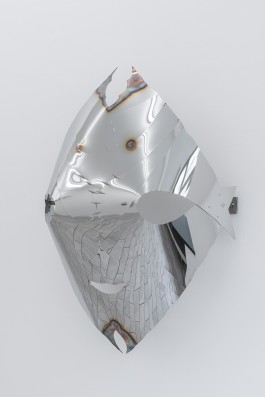

„jugentlich“, 2023 121 x 60 x 40 cm stainless steel photo: Dirk Tacke
„lüstern und schonungslos“, 2022 135 x 81 x 46 cm stainless steel, cowhide photo: Dirk Tacke
recent
HURTING SCULPTURES at Bilker Bunker, Düsseldorf, Germany
01.10.2025 - 29.10.2025
with Jenny Ayala and Stephan Marienfeld
see the full documentation here
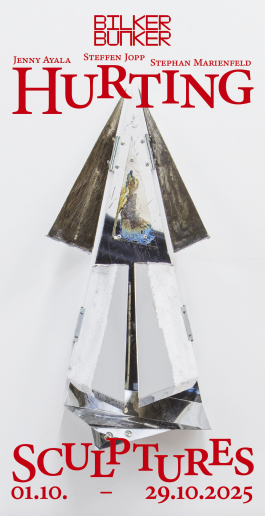
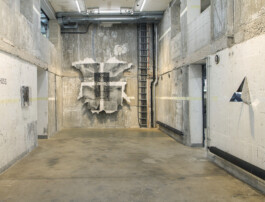
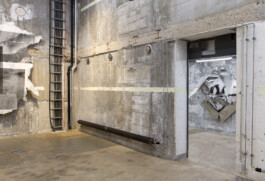
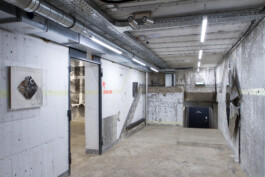
installation view "Hurting Scuptures" at Bilker Bunker, Düsseldorf 2025
Wohnung Lauxtermann VOL. 7 at Galerie 3 A.P. Düsseldorf, Germany
Visits to the exhibition are possible on request.
The next public guided tours will take place on 6./11./13.*/17.*/27. November
from 3 – 6 pm (*5-7pm); No pre-booking necessary.
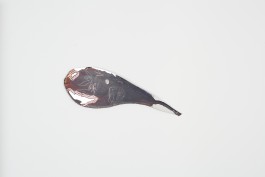
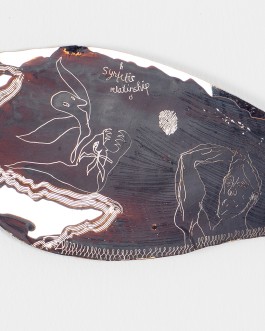
Steffen Jopp, "synthetic relationship", 2023/2024, 15 x 50 cm, asphalt varnish on stainless steel
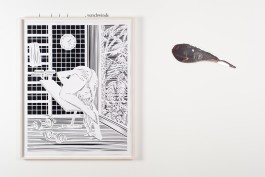
Sonja Yakovleva, courtesy Robert Grunenberg, Berlin
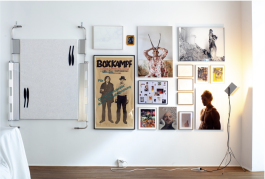
photos: courtesy Galerie 3 A.P.
The decentralized memorial (Path of Liberation) today commemo- rates the local resistance against Nazi-Germany and the liberation of the city of Düsseldorf in April 1945 via six stations in form of information ste- les. In the former apartment of master baker Josef Lauxtermann – today Station 1 at Fürstenwall 74 – members of the resistance group met from the beginning of the Second World War to discuss politics and plan how the city could be handed over to the Allies. This is where the „Aktion Rheinland“ was organised. (Source: Federal Agency for Civic Education, NS memorials)
The exhibition and residency project WOHNUNG LAUXTERMANN, conceived and curated by Aileen Treusch, enables artists to use the premises at Fürstenwall 74 for their work to bring this historic address back into the active life of the city. Since the beginning in February 2023, various program strands have focused on the social role of art and design and their potential for participation. Thematically, the exhibited positions deal with various questions of orientation, cohesion, democracy and domesticity. The tour begins on the first floor at the staircase and leads through office space, storage and work rooms on the upper floors of Fürstenwall 74. „In order to experience democracy, the feeling of selfefficacy and agency must be activated.“ Participating artists therefore site-specifically deal with participation and physicality. The boundaries of different artistic design practices are opened wide. Young and deceased artists from different and not only geographical backgrounds come together. For the first time, loans from artists‘ studios and private collections will be on display. Together they form a fictitious apartment: rooms that are timeless, filled with all time. What dimensions does a work need to attract attention? What does it actually mean to have „format“, to deal „confidently“ with free spaces? The works largely take up figurative or architectural moments and deal with the role of artists, curators and collectors in their environment and network.
Text by Galerie 3 A.P.
participating artists:
Joschua Yesni Arnaut, Roberto Barbosa, Joseph Beuys, Willi Bucher, Felix Anatol Findeiß, Jacqueline Hen, Sonja Heim, Steffen Jopp, Nadine Karl, Max Klinger, Helga Kneidl, Carolin Liebl & Nikolas Schmid-Pfähler, Ulrike Markus, Toni Meyer, Julie Mia, Philipp Naujoks, Miriam Schenkirz, Robert Schittko, Wayne Thiebaud, Catharina Szonn, Ellen Wagner, Lara Werth, Sonja Yakovleva
with further objects and contributions by Alex Leo Freier, Monster Mansion, Aleksandra Mir & Tim Griffin
Intersections at NOUVEAUX DEUXDEUX, Munich, Germany
July 19th - August 24th, 2024
participating artists: Neringa Vasiliauskaite, Steffen Jopp, Sarah Doerfel, Benedikt Hipp
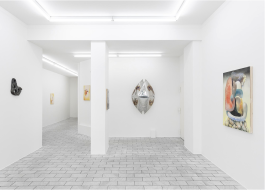
photo by Dirk Tacke, courtesy NOUVEAUX DEUXDEUX
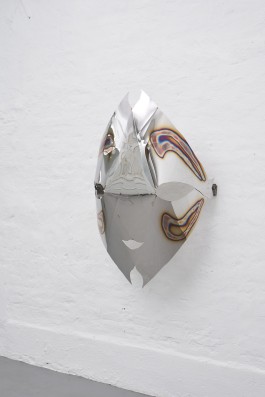
Steffen Jopp,"konzentriert und unentschlossen", 2022, 133 x 80 x 45,5 cm, stainless steel
photo: Andreas Fechner